
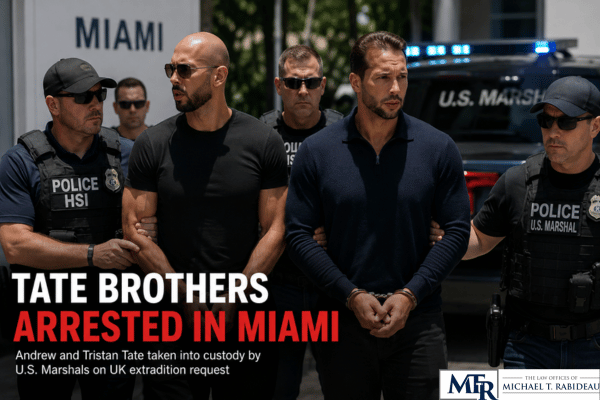

Andrew and Tristan Tate — the influencer brothers at the center of a years-long international legal saga — were arrested by U.S. Marshals in Miami on Saturday, July 18, 2026. The arrest wasn’t the result of a new American criminal case. It was carried out on behalf of the United Kingdom, which has issued an extradition request tied to a fresh wave of sexual offense charges.
Here’s a plain-English breakdown of what’s going on, followed by direct answers to the two questions people keep asking: are they facing charges in the U.S., and could a “US Attorney” represent them in the UK case?
What happened in Miami
The Tates, who hold dual U.S. and U.K. citizenship, were taken into custody in Miami on a sealed warrant just before Andrew was scheduled to co-host a bareknuckle boxing event. The arrest came after the U.K.’s Crown Prosecution Service authorized a large batch of new charges — bringing the combined total against the two brothers to more than 50, including rape, human trafficking, assault, and offenses involving indecent images of a child. The new allegations, reported by several women, relate to conduct authorities say occurred in the East of England, north of London, between 2010 and 2017.
The brothers were expected to appear before a federal magistrate in Miami on Monday, July 20, where a U.S. district judge will eventually decide whether they meet the legal conditions for extradition to the U.K. Their attorney has said they intend to fight the extradition and denied all the allegations.
This is only the latest chapter. The Tates have also faced a separate, ongoing criminal case in Romania since 2022 involving trafficking and organized crime allegations, and Romanian courts have already approved their eventual extradition to the U.K. once those proceedings conclude. The brothers left Romania in early 2025 after travel restrictions on them were lifted, reportedly following pressure from Trump administration officials, and had been living largely in the U.S. since.
Are they facing charges in the United States?
Not at the federal level, as things stand. The Miami arrest was made to satisfy a U.K. extradition request — it wasn’t the result of a new U.S. indictment, and no federal charges against the brothers have been announced by the Department of Justice.
That said, there is a separate thread worth noting: Florida’s state government has an active criminal investigation into the Tates, which Florida Governor Ron DeSantis announced after the brothers relocated to the state. As of now, that inquiry hasn’t produced formal state charges either. So the honest answer is: the U.S. is currently acting as the location of arrest and the venue for extradition proceedings, not as a jurisdiction actively prosecuting the brothers itself.
Could a “US Attorney” represent them in the UK?
This question hinges on a common mix-up in terminology, so it’s worth untangling.
In the American legal system, a “U.S. Attorney” is a specific, official title — it refers to a federally appointed prosecutor who represents the government in federal criminal cases. U.S. Attorneys work for the Department of Justice and bring charges on behalf of the United States; they don’t defend private individuals, and they have no authority or role in a foreign country’s courts. So a U.S. Attorney, in the formal sense, could not represent the Tates in a U.K. criminal case — that’s simply outside what the position does.
What the Tates do have is a private American defense lawyer, Joseph McBride, who has represented them in various U.S. proceedings, including their ongoing defamation lawsuit in Florida and now their fight against extradition in federal court. McBride’s role, however, is limited to matters that fall under U.S. jurisdiction — like whether the extradition request should be granted. He is not licensed to practice law in England and Wales, and the actual U.K. criminal case, if it proceeds, would require the Tates to be represented by U.K.-qualified solicitors and barristers. They’ve used U.K. legal representation before; a British firm has previously spoken on their behalf regarding the timeline of their return to face U.K. charges.
So to summarize: no, a U.S. Attorney (the prosecutorial title) couldn’t represent them in the U.K., and even a private American lawyer’s role is confined to the U.S. side of this case — extradition — rather than the substantive criminal trial that would eventually happen on U.K. soil.
What happens next
The extradition process itself could take months. A U.S. district judge will need to determine whether the legal threshold for extradition under the U.S.–U.K. treaty is met, and the brothers’ legal team has signaled they’ll contest it, reportedly citing a “political offense” argument tied to the treaty’s exceptions. Ultimate sign-off on any extradition rests with the U.S. Secretary of State. Meanwhile, the Romanian case remains unresolved, and under a prior understanding between Romania and the U.K., the Tates weren’t expected to face U.K. extradition until Romanian proceedings concluded — a point their attorney has argued was violated by the timing of this arrest.
For now, the brothers remain in federal detention in Miami awaiting the next stage of the extradition hearing.
Facing Serious Criminal Charges in Florida?
Call Today
If you or a loved one has been arrested or charged with a crime in Florida, you need strong legal representation on your side to protect your future. The stakes are high and a conviction can haunt you for life. Don’t leave your fate in the hands of an overworked public defender. Hire a former prosecutor who knows how to get charges reduced or dismissed.
At The Law Offices of Michael T. Rabideau, we provide aggressive and strategic criminal defense for clients across South Florida. As a former Assistant State Attorney, founder Michael Rabideau knows the ins and outs of the local justice system and how to build an effective defense.
With over 20 years of experience exclusively defending the accused, we have successfully represented hundreds of clients facing charges such as:
— Assault & Battery
— Child Abuse & Child Neglect
— Computer Crimes
— Domestic Violence
— Driving Violations
— Drug Crimes Lawyer
— DUI
— Expungements
__ Federal Crimes
— Firearms Offense
— Fleeing & Eluding
— Hit & Run
— Juvenile Crimes
— Manslaughter
— Marijuana Possession Lawyer
— Murder
— Probation Violations
— Resisting Arrest
At The Law Offices of Michael T. Rabideau, we conduct thorough investigations, employ expert witnesses, leverage technical defenses, negotiate with prosecutors, and handle every aspect of the pretrial and trial process. We are not afraid to take your case to trial if it is in your best interest.
Don’t Leave Your Future to Chance – Schedule a Free Consultation Today
We also understand the far-reaching consequences of criminal charges, even for first-time offenders. That is why we work tirelessly both in and out of the courtroom to protect your rights and limit the impact on your record.
A customized defense strategy can make all the difference between a guilty verdict and a dismissal. Don’t leave your future up to chance or assume you have no options. Schedule a free consultation today with The Law Offices of Michael T. Rabideau to discuss your situation confidentially with an experienced criminal defense attorney.
Affordable Payment Plans and Flexible Appointments Available
We make our services accessible by offering reasonable rates as well as personalized monthly payment plans to fit your budget. We also accommodate evening and weekend appointments at all three of our offices in West Palm Beach, Wellington and Boca Raton.
Don’t Wait to Get the Representation You Deserve
The Law Offices of Michael T. Rabideau are here for you when you need us most. Our sole focus is protecting your rights and resolving your criminal case as favorably as possible. Don’t go through this fight alone. With an aggressive defense lawyer on your side, you can avoid harsh penalties so this mistake doesn’t ruin your entire future.
FAQ
1. Are Andrew and Tristan Tate facing criminal charges in the United States? No. As of now, no federal charges have been filed against them in the U.S. Their arrest in Miami was carried out to satisfy a United Kingdom extradition request, not a new American criminal case. Florida does have an active state-level investigation into the brothers, but it has not produced formal charges.
2. Why were the Tate brothers arrested in Miami if the charges are from the UK? U.S. Marshals arrested them on behalf of British authorities under the U.S.–U.K. extradition treaty. When one country wants a person located in another country to face charges, it can request extradition, and local law enforcement — in this case, U.S. Marshals — carries out the arrest while a U.S. court decides whether to grant the request.
3. Could a “US Attorney” represent the Tate brothers in their UK case? Not in the formal sense of the title. A “U.S. Attorney” is a federally appointed prosecutor who represents the government in American federal cases — they don’t defend individuals and have no authority in foreign courts. The Tates’ private American lawyer can only represent them in matters under U.S. jurisdiction, like the extradition hearing. A UK criminal trial would require lawyers licensed in England and Wales.
4. What happens during an extradition hearing? A U.S. district judge reviews whether the legal requirements under the extradition treaty are met — for example, whether the alleged conduct is a crime in both countries and whether the evidence meets the required standard. The defense can contest the request, including on narrow legal grounds like the treaty’s political-offense exception. Final approval of any extradition rests with the U.S. Secretary of State.
5. What is the status of the Tate brothers’ separate case in Romania? Romanian prosecutors have pursued the brothers since 2022 on charges including human trafficking and forming an organized criminal group. Romanian courts have already approved their eventual extradition to the U.K. once that case concludes, and the brothers have continued attending required Romanian court appearances even while living in the U.S.