

The Tate Brothers’ Miami Arrest: What It Teaches About Warrants, Florida Extradition, and Serious Charges in South Florida
When U.S. Marshals arrested Andrew and Tristan Tate in Miami this summer, the headlines focused on the celebrities. The more useful story for South Florida families is the process behind the arrest. People are picked up every week in Miami-Dade, Broward, and Palm Beach County on warrants from another county, another state, or the federal system, and most have no idea what happens next or what is involved in a Florida Extradition.
Lets talk about the Tate case in brief, then we’ll explain what an out-of-area warrant arrest means for you or a loved one, how Florida extradition works, and what to do in the first 24 hours.
The Tate Case in Brief

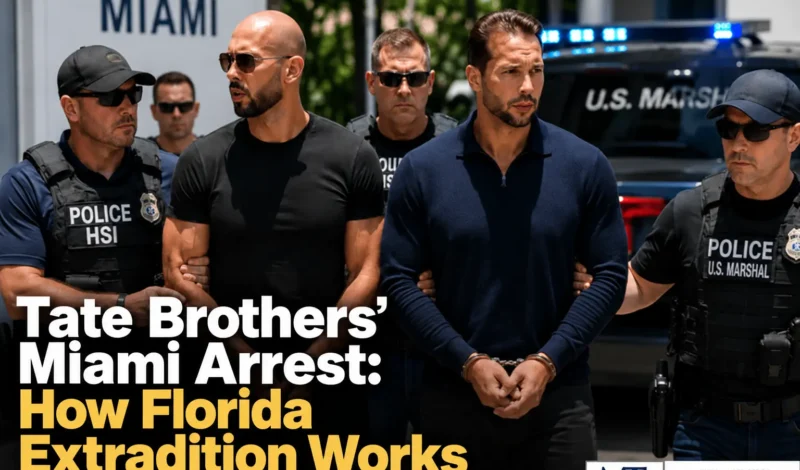
- The arrest: U.S. Marshals took the brothers into custody in Miami on July 18, 2026, at the request of the United Kingdom, which has charged them with rape, sex trafficking, and related offenses.
- No U.S. charges: The arrest was made to honor a foreign extradition request. No U.S. federal charges have been announced.
- Bail denied: In September, a federal magistrate judge in Miami denied their request for release, so they remain at the Federal Detention Center in Miami.
- Next step: The court set separate final extradition hearings for November 19 (Andrew) and November 20 (Tristan).
- Their position: Both brothers deny all allegations.
An Florida extradition hearing is not a trial. The judge does not decide guilt or innocence. The judge decides whether the legal requirements for sending someone to face charges elsewhere have been met. That same basic idea applies, on a much smaller scale, to everyday warrant arrests in Florida.
Arrested in South Florida on a Warrant From Somewhere Else
Most out-of-area arrests have nothing to do with international treaties. They usually start with something routine:
- A traffic stop where the officer runs your name and finds an active warrant
- An old probation violation or missed court date in another Florida county
- A warrant from another state that was entered into the national NCIC database
- A sealed federal indictment from another district
- An investigation you did not know about until officers showed up at your door
Where the warrant came from decides which rules apply, how long you can be held, and whether you can get out on bond.
Three Types of Warrant Arrests Compared
| Type of Warrant | Who Handles It | Typical Process | Bond Outlook |
|---|---|---|---|
| Another Florida county | Local jail and the county that issued the warrant | First appearance within 24 hours, then transport to the issuing county | Often set by the warrant or addressed by the issuing county’s judge |
| Another state | Florida court under Chapter 941, Florida Statutes (Uniform Criminal Extradition Law) | Fugitive hold, option to waive or contest Florida extradition, Governor’s warrant if contested | Bond is generally available unless the offense carries death or life in prison |
| Federal or foreign | U.S. District Court, Southern District of Florida | Initial appearance, identity and detention hearings, then transfer or Florida extradition hearing | Varies for federal cases; very difficult in international extradition |
How Interstate Extradition Works in Florida

If another state wants you back, Florida does not simply put you on a plane. Under Chapter 941, you have rights before you can be sent anywhere.
- Fugitive hold: A Florida judge can hold you for up to 30 days while the other state obtains a Governor’s warrant. That period can be extended by up to 60 more days.
- Right to a lawyer: You have the right to counsel before you are surrendered.
- Waiver option: You can sign a written waiver in front of a judge and agree to go back voluntarily. This can shorten jail time, but it gives up your ability to challenge the process.
- Challenging Florida extradition: If you contest it, the issues are narrow: whether you are the person named, whether the paperwork is in order, whether you are charged in the other state, and whether you were present there when the crime allegedly happened.
- Bond: Florida judges can usually set bond during the fugitive hold, except in cases punishable by death or life imprisonment.
Waiving or fighting Florida extradition is a strategic decision. Sometimes contesting buys time to resolve the underlying case with the other state. Sometimes waiving gets you out of a Florida jail faster. That call should be made with a lawyer who looks at both cases, not on the jail phone.
Federal Arrests in the Southern District of Florida
The Tates appeared in federal court in Miami because the Southern District of Florida covers Miami-Dade, Broward, Palm Beach, and several other counties. Federal arrests in this district, whether on a local indictment or a warrant from another federal district, move quickly:
- Initial appearance: Usually the next business day before a magistrate judge.
- Detention hearing: Prosecutors may ask the court to hold you without bond. These hearings are often scheduled within a few days.
- Identity hearing: If the warrant is from another district, you can require the government to prove you are the person named.
- Transfer: If the case belongs elsewhere, you may be transported by the Marshals, which can take weeks.
Attorney Michael T. Rabideau is admitted to practice in the U.S. District Court for the Southern District of Florida and handles federal criminal defense cases in addition to state court matters.
Serious Charges Like the Ones in the Headlines

The Tate case involves allegations that Florida also prosecutes aggressively. If you are under investigation or charged with any of these, early legal advice matters more than in almost any other type of case:
- Sex crimes, including sexual battery and solicitation charges
- Human trafficking, which Florida treats as a first-degree felony or higher depending on the facts
- Computer crimes, including allegations involving illegal images
- Assault and battery and other violent offenses
- Serious felonies that carry mandatory prison or sex offender registration
Cases like these often begin with an investigation long before any arrest. Detectives may call, ask you to come in “just to talk,” or reach out through a third party. Anything you say can be used to build the case. You have the right to decline an interview and speak with a criminal defense lawyer first.
What to Do in the First 24 Hours After an Arrest
- Stay quiet. Do not discuss the case with officers, cellmates, or anyone on a recorded jail line.
- Ask for a lawyer. Say it clearly, then stop talking.
- Note the details. Family members should write down the booking number, the jail, and the charge or warrant listed.
- Prepare for first appearance. In Florida, a person arrested is brought before a judge within 24 hours. A lawyer at that hearing can argue for reasonable bond and release conditions.
- Do not sign anything about waiving Florida extradition or consenting to searches until you have legal advice.
Frequently Asked Questions
| Question | Answer |
|---|---|
| Are the Tate brothers facing charges in the United States? | No U.S. federal charges have been announced. They were arrested in Miami to honor a United Kingdom extradition request, and they deny all allegations. |
| Could a “U.S. Attorney” represent them in the UK? | No. A U.S. Attorney is a federal prosecutor, not a defense lawyer. Their private American lawyer handles the U.S. extradition fight, and any UK trial would require lawyers licensed in England and Wales. |
| Can I be arrested in Florida for a warrant from another state? | Yes. Florida police can arrest you on an out-of-state warrant and hold you as a fugitive while the other state requests your return under Chapter 941. |
| How long can Florida hold me on an out-of-state warrant? | Generally up to 30 days while the other state obtains a Governor’s warrant, with a possible extension of up to 60 more days. |
| Should I waive Florida extradition? | It depends on the charges in both states, your bond options, and your defense strategy. Talk to a lawyer before signing a waiver. |
| Can I get bond on an out-of-state warrant? | Often yes, unless the charge carries death or life in prison. A lawyer can argue for bond at your first appearance. |
| Is a Florida extradition hearing a trial? | No. The judge decides whether the legal requirements for transfer are met, not whether you are guilty. |
| Does Rabideau Law handle federal cases? | Yes. Michael T. Rabideau is admitted to the U.S. District Court for the Southern District of Florida and handles both state and federal criminal defense. |
Talk to a South Florida Criminal Defense Lawyer
Whether the warrant is from another county, another state, or the federal system, the decisions made in the first few days can shape the entire case. Michael T. Rabideau has defended clients in Florida courts since 1999 and works personally on every case, from the first consultation through the final resolution.
- Offices in West Palm Beach, Wellington, and Boca Raton
- State and federal criminal defense across South Florida
- Free initial consultation and payment plans available
Call (561) 820-4848 or request a free consultation today.
This article is for general information only and is not legal advice. Every case is different. Reading this article does not create an attorney-client relationship.